
St. Louis Urban Legend: Hitchhiker Annie
Just about every region, city, and small town has its share of urban legends, and St. Louis isn't any different. Despite what most Anthropologists claim, most urban legends I've found through my own research have an initial spark of truth. Sometimes, a notable event can spark a long-standing story that becomes part of a place's folklore and oral history. Over time, this story usually gets exaggerated and morphs into something paranormal, but there's always an actual event that triggers it.
Now most major cities have a "Hitchhiker Annie" story, and St. Louis is no different. Now, the basic premise of every Hitchhiker Annie story goes something like this. It's usually a dark, rainy, or snowy evening, and a motorist is traveling down a desolate road next to a cemetery. The motorist sees a young woman walking along the side of the road and stops to offer her a ride. The young woman gets into the vehicle and says nothing to the driver. The driver pulls away, and shortly after, he turns to ask the woman where she is going. Upon asking the question, the young woman vanishes from the vehicle without a trace.
St. Louis has its own version of this story, which is supposed to take place along Calvary Avenue. Calvary Avenue runs between Bellefontaine and Calvary Cemeteries. Calvary Avenue is an east-to-west running street that connects North Broadway and West Florissant Avenue. Calvary Avenue is a "Y" shaped street comprising Calvary Avenue, South Calvary Avenue, and North Calvary Avenue. Where these three streets meet is where the St. Louis version of the Hitchhiker Annie story started.
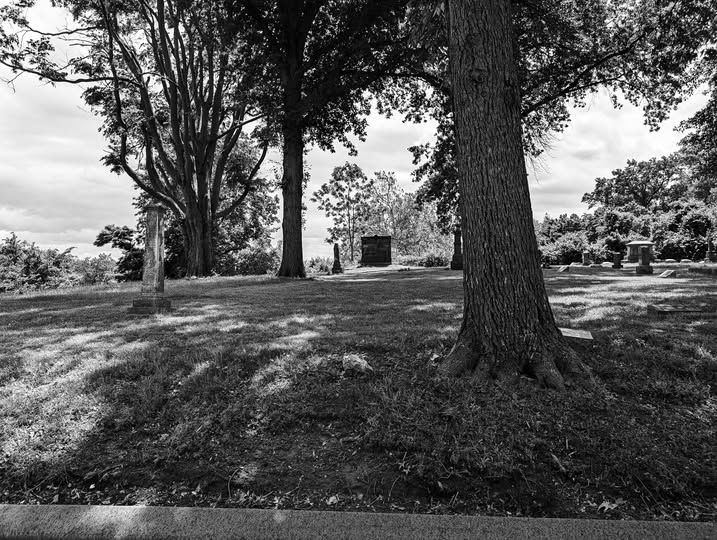
If you go to where these three streets meet and look up the hill on the Calvary Cemetery side of the intersection, you will see the crypt of Thomas Caute and Heloise Marie Reynolds. Thomas Reynolds has a checkered past when it comes to St. Louis History. During the American Civil War, he supported the Confederacy. He advocated overthrowing the Pro-Union State Government of Missouri and forming a Pro-Confederacy State Government, in which he would serve as its Governor. Despite his checkered past, Thomas Reynolds loved his wife Heloise dearly. Heloise was described as one of the most beautiful women in St. Louis.
Heloise died of pneumonia, and her death started a long and painful mourning period for Thomas, which ultimately ended in his suicide. Thomas ended his life by throwing himself down an elevator shaft in the St. Louis Customs House. But years after his wife's death, Thomas was known to sit outside his wife's crypt that sat on the hill above the Calvary Avenue intersection for hours talking to his deceased wife. Travelers up and down Calvary Avenue reported seeing him sitting next to his wife's crypt. After Thomas' death, people traveling Calvary Avenue continued to report seeing Thomas Reynolds sitting on top of the hill, next to the crypt, still holding his daily vigil.
Fast-forward to the days of the automobile and the years of exaggeration later, and Thomas Reynolds' ghost story could very well be the initial spark for St. Louis' version of the Hitch Hike Annie urban legend. Now I have traveled up and down Calvary Avenue several times over the years to verify the urban legend, to no avail. But I have spoken with St. Louisans who adamantly claim they saw Annie walking along Calvary Avenue


This was a fascinating dive into how local folklore evolves. It’s compelling to think that the tragic history of the Reynolds family likely morphed into the Annie legend over time. While I haven’t spotted any spirits on Calvary Avenue myself, I’m obsessed with visualizing these haunting tales. I’ve recently been using an Image to Image AI Generator to recreate scenes from local myths based on historical descriptions. It really brings these eerie legends to life in a whole new way.
Go High Level Expert
Nice
What stands out to me in modern Pool Design is customization. Space Landscape Designs looks like they offer tailored solutions rather than one-size-fits-all layouts.
This “St. Louis Urban Legend: Hitchhiker Annie” article makes for a chilling read about folklore and local ghost stories. It’s fascinating how these tales endure and spark curiosity. On an unrelated note, I was also surprised to learn about savani quintanilla net worth it’s always interesting when celebrity insights pop up alongside legends